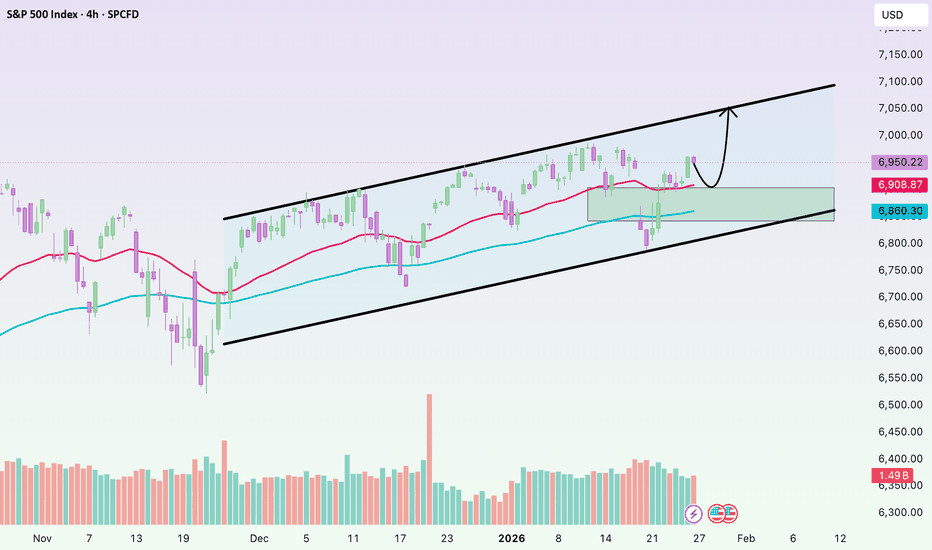
What’s Driving the S&P 500 Right Now?
Observing the S&P 500 at this stage, I believe the key point is not any single headline, but the fragile balance between expectations and reality. The market is no longer reacting strongly to good news, yet it tends to wobble quickly when faced with less favorable signals—classic behavior after a prolonged rally.
The Fed: It’s No Longer About Rates, but Expectations
The Federal Reserve is not more hawkish than before, but it also hasn’t delivered a dovish signal strong enough to ignite a fresh wave of buying. Most expectations for easing have already been priced in, creating an asymmetric reaction to news: positive developments merely help the market hold its ground, while cautious or ambiguous messages are enough to trigger volatility.
This explains why the S&P 500 can maintain elevated levels but struggles each time it approaches the 7,000 zone. There is no panic selling, yet there is also no catalyst compelling investors to pay meaningfully higher prices.
Inflation and Economic Data: A “No Panic, No Euphoria” Zone
Recent data suggest that inflation is not reaccelerating, but it is also not cooling as quickly as initially hoped. This is an environment where the Fed can afford to wait, and where large investors are in no rush to make aggressive bets.
For the S&P 500, such conditions typically result in sideways movement, technical pullbacks, and trend-based consolidation rather than steep rallies. The market needs clearer data to break out of its current state of hesitation.
Earnings: Capital Is Becoming More Selective
One notable development this earnings season is the increasing divergence beneath the surface. Some heavyweight stocks continue to deliver solid growth and support the index, while many others are offering more cautious forward gu